
Learn with CyBOK
CyBOK
Understand the Bigger Picture of Cybersecurity with CyBOK
CyBOK (The Cyber Security Body of Knowledge) is an international body of knowledge developed with support from the UK’s National Cyber Security Programme and contributions from researchers in the UK and cyber security experts around the world.
It codifies foundational and generally recognised knowledge in cyber security, providing a shared knowledge base for education, professional development and practice.
At Cyber Hiroshima, we use CyBOK v1.1 and its 21 Knowledge Areas as a structured starting point for understanding the field and moving from knowledge to practice.
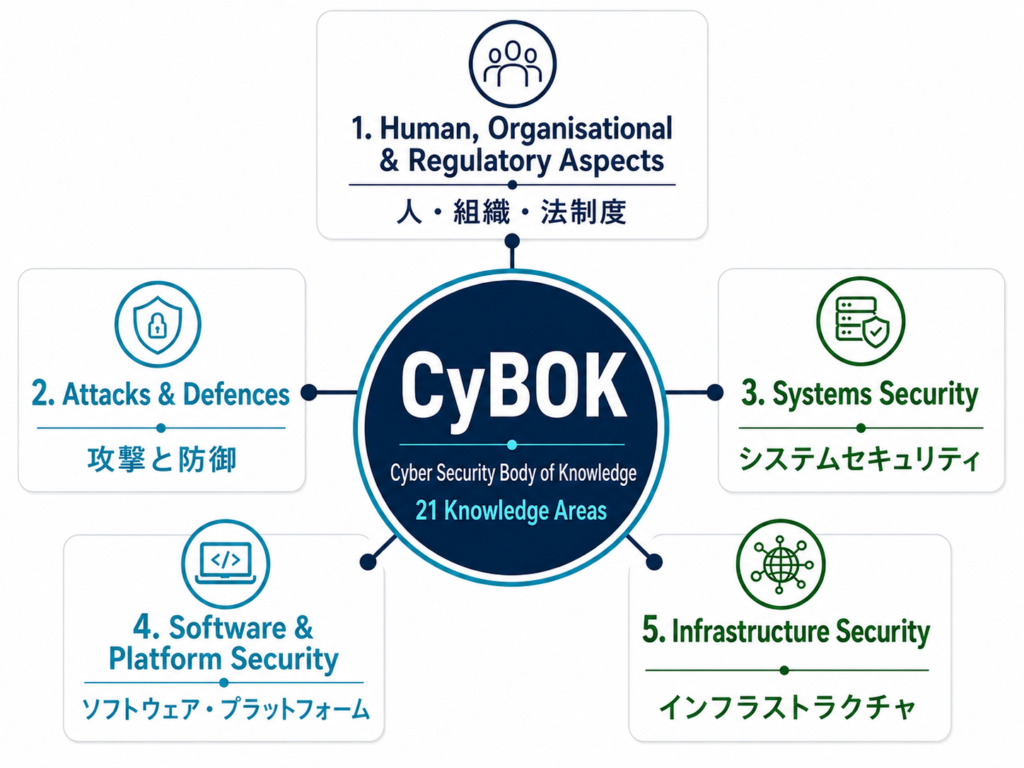
WHAT IS CYBOK?
A Shared Foundation for Cybersecurity Knowledge
CyBOK codifies the foundational and generally recognised knowledge that underpins cyber security.
Rather than being a single textbook, it provides a guide to established knowledge found across textbooks, academic research, technical reports, white papers and standards.
CyBOK v1.1 organises this knowledge into five categories and 21 Knowledge Areas (KAs). These areas are interconnected rather than isolated, so learners can move across different KAs according to their goals, interests and professional needs.
01
21
Knowledge Area
Covering the core areas of cybersecurity knowledge.
02
5
Broad Categories
Organising the 21 Knowledge Areas into a clear overall structure.
03
115+
Global Experts
Developed with contributions from experts from around the world.
04
Open
Freely Accessible
Open and freely available for education, training, and professional development.
FIVE CATEGORIES
Understand the Bigger Picture through Five Categories
Start with the five categories to get an overview of CyBOK. Select a category to jump to the corresponding area in the 21 Knowledge Areas grid below.
21 KNOWLEDGE AREAS
Explore the 21 Knowledge Areas
Select a Knowledge Area (KA) to view a concise overview, its suggested learning stage and learning guidance from Cyber Hiroshima.
Note: Entry, Core and Advanced are learning guides developed by Cyber Hiroshima. They are not official CyBOK classifications or difficulty levels.
HOW TO LEARN
Start Where It Makes Sense for You
CyBOK contains 21 Knowledge Areas, but you do not need to study them in numerical order from KA01 to KA21.
Where you start depends on your goals. Someone new to cyber security, someone working with a particular technology, and someone responsible for organisational risk or governance will each need a different combination of knowledge.
Cyber Hiroshima uses Entry, Core and Advanced as a practical guide to help learners navigate the 21 KAs. Start with an area that relates to your interests or current challenges, then expand into connected Knowledge Areas as your understanding develops.
Once you have built an understanding through CyBOK, hands-on labs such as SudoRange can help you test that knowledge in practice and deepen your understanding by moving between theory and experience.
Start with an Accessible Entry Point
Begin with areas where results are easier to observe, such as Web & Mobile Security, Network Security, Authentication, Authorisation & Accountability, or Software Security.
Connect Related Knowledge Areas
Do not treat a topic in isolation. Explore how it connects with adjacent areas across attacks, defences, systems, software and organisational considerations.
Put Knowledge into Practice
Use hands-on exercises and cyber ranges to turn CyBOK concepts into practical actions and decisions.
SUPPLEMENTARY GUIDES
Keep Learning as Cyber Security Evolves
In addition to the 21 Knowledge Areas that form the core of CyBOK, Supplementary Guides cover emerging fields and themes that cut across multiple KAs.
Topic Guides bring together material from several Knowledge Areas to provide a unified view of cross-cutting themes. Knowledge Guides review the current state of knowledge in developing areas, including key issues, emerging techniques and open research questions.
Together with the 21 Knowledge Areas, these guides provide a way to continue learning as cybersecurity evolves.
Topic Guides
Explores how artificial intelligence and machine learning can be applied to cyber security, including use cases, evaluation, lifecycle considerations and common challenges.
Introduces the principles, architectures, technologies, services and security controls used to protect data, infrastructure and applications in cloud environments.
Examines how cybersecurity and safety should be considered together in systems and infrastructure where digital compromise can affect physical operations and safety.
Knowledge Guides
Examines attacks against machine learning systems, defensive approaches, privacy risks and the wider security challenges associated with AI and ML models.
Applies economic thinking to cyber security, including incentives, security investment, organisational decision-making and public policy.
SOURCE & LICENCE
Sources & Licence
This page draws on The Cyber Security Body of Knowledge (CyBOK) Version 1.1.0 and the official CyBOK Supplementary Guides.
The five categories and official English names of the 21 Knowledge Areas follow the CyBOK source material. The concise summaries, learning stages and learning guidance presented on this page are editorial content prepared by Cyber Hiroshima.
Main Sources
- The Cyber Security Body of Knowledge (CyBOK), Version 1.1.0, 31 July 2021
- CyBOK Supplementary Guides
- Topic Guide — AI for Security, Issue 1.0.0, July 2023
- Topic Guide — Cloud Security, Issue 1.0.0, March 2026
- Topic Guide — Security-Informed Safety, Issue 1.0.0, July 2026
- Knowledge Guide — Security and Privacy of AI, Issue 1.0.0, July 2023
- Knowledge Guide — Security Economics, Issue 1.0.0, January 2024
CyBOK v1.1
The Cyber Security Body of Knowledge (CyBOK), Version 1.1.0, July 2021.
The five Categories and 21 Knowledge Areas presented on this page are based on CyBOK v1.1.
Supplementary Guides
The Supplementary Guides referenced above are also licensed under the Open Government Licence v3.0. The applicable CyBOK attribution is determined by the publication year of each guide.
Licence / Attribution
CyBOK Version 1.1.0 © Crown Copyright, The National Cyber Security Centre 2021, licensed under the Open Government Licence v3.0.
The Supplementary Guides referenced above are also licensed under the Open Government Licence v3.0. The applicable CyBOK attribution is determined by the publication year of each guide.
AI for Security / Security and Privacy of AI
CyBOK © Crown Copyright, The National Cyber Security Centre 2023, licensed under the Open Government Licence v3.0.
Security Economics
CyBOK © Crown Copyright, The National Cyber Security Centre 2024, licensed under the Open Government Licence v3.0.
Cloud Security
CyBOK © Crown Copyright, The National Cyber Security Centre 2025, licensed under the Open Government Licence v3.0.
Security-Informed Safety
CyBOK © Crown Copyright, The National Cyber Security Centre 2026, licensed under the Open Government Licence v3.0.
For details of the Open Government Licence v3.0, please refer to the official licence published by The National Archives.
NEXT STEP
Turn Knowledge into Practice
Once you understand the principles behind cybersecurity through CyBOK, the next step is to test that knowledge in a practical environment.
Cyber Hiroshima connects the CyBOK Knowledge Areas with hands-on learning through SudoRange, helping learners move between knowledge and practice as they build deeper understanding.